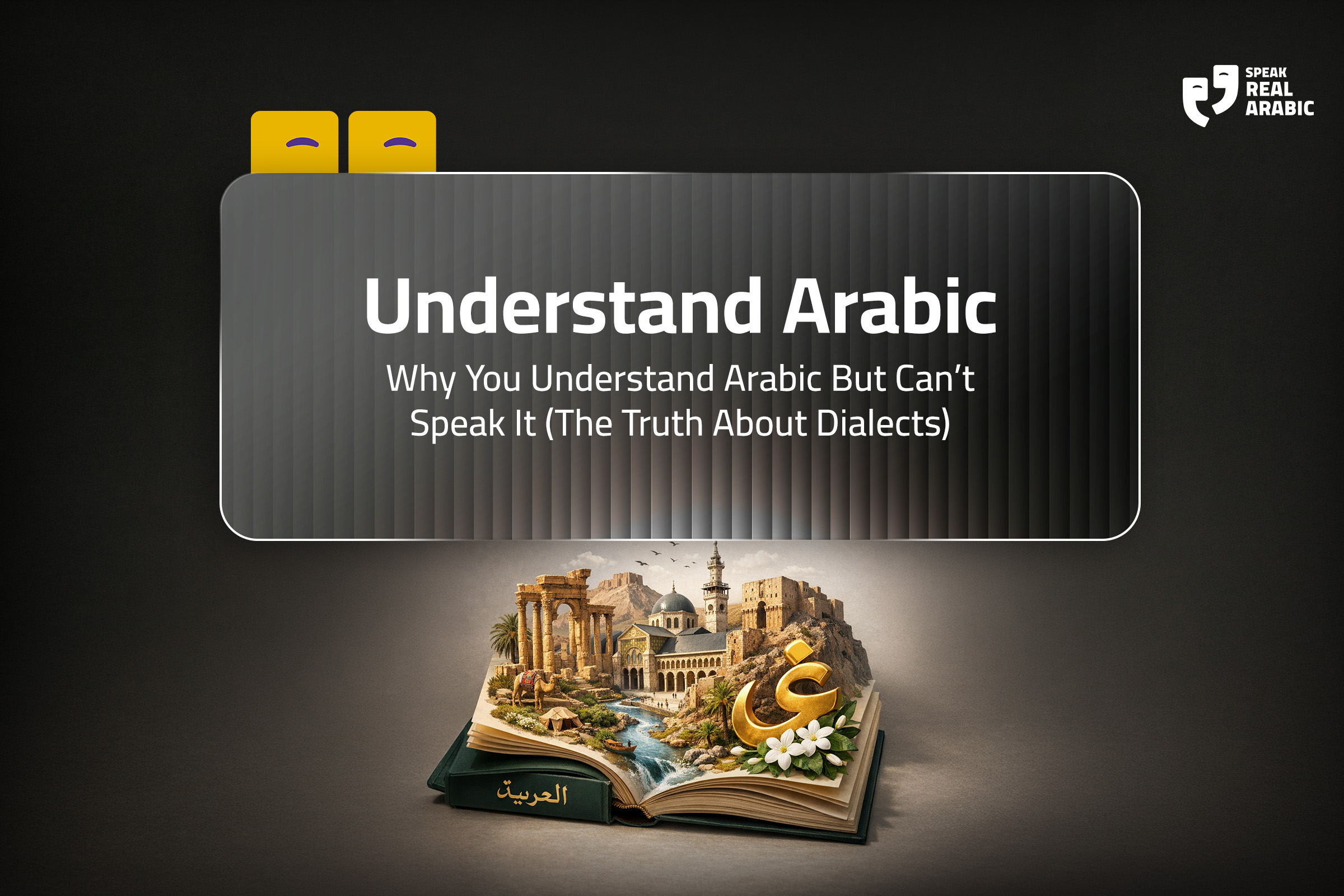
Why You Understand Arabic But Can’t Speak It (The Truth About Dialects)
If you’ve ever felt like:
“I understand Arabic… but I can’t speak it”
You’re not alone.
This is one of the most common frustrations for Arabic learners.
You study, you memorize vocabulary, you understand a lot…
But when it’s time to speak?
Nothing comes out.
Or worse…
You freeze.
So what’s really going on?
Let’s talk about the truth most people don’t tell you
You Didn’t Learn the Arabic People Actually Speak
Most learners start with Modern Standard Arabic (MSA).
And that makes sense.
It’s structured, clear, and used in books, news, and formal settings.
But here’s the problem:
👉 People don’t actually speak MSA in daily life.
Instead, they speak dialects like Syrian Arabic, Egyptian, Lebanese, and more.
So when you learn sentences like:
“Hal tureed an tadhhab ma‘i?”
(Do you want to go with me?)
In real life, you’ll hear:
👉 “بدك تجي؟” (Baddak teji?)
Shorter. Faster. Completely different.
And suddenly…
Your brain goes: Wait… what?
🤯 Your Brain Is Translating… Instead of Communicating
When you try to speak, your brain often does this:
Think in English
Translate to MSA
Try to adjust to a dialect
Speak
That’s 4 steps.
No wonder you feel slow or stuck.
Native speakers?
They don’t translate.
They just speak.
⚡ Dialects Are Faster, Shorter, and More Emotional
In dialects like Syrian Arabic, people:
Drop words
Shorten sentences
Change meanings with tone
For example:
👉 “تمام” (tamam)
In MSA, it means “okay.”
But in real life, it can mean:
Yes
I understand
Stop talking
I’m annoyed 😅
Same word… different feelings.
If you only learned “one meaning = one word”
This becomes confusing fast.
😵 Why Native Speakers Sound “Too Fast”
One of the biggest shocks for Arabic learners is this:
👉 You understand your teacher…
But you don’t understand native speakers.
Why?
Because native speakers don’t speak “carefully.”
In real conversations, people:
connect words together
skip sounds
interrupt each other
use slang constantly
For example, you may learn:
👉 “كيف حالك؟” (keef halak?)
But in real Syrian conversations, it might sound more like:
👉 “كيفك؟” (keefak?)
👉 “كيفك اليوم؟”
👉 “شو الأخبار؟”
And people say them FAST.
At first, it sounds impossible.
But the problem isn’t your intelligence.
Your ears simply haven’t been trained for real spoken Arabic yet.
That’s why listening to authentic conversations is so important.
The more real Arabic you hear…
The less “fast” Arabic feels.
🎭 Arabic Is Not Just Words, It’s Tone, Context, and Feeling
Let’s take a simple word:
👉 “اي” (eh)
Depending on tone, it can mean:
Yes 🙂
Maybe 😐
I don’t care 😒
Excited agreement 😄
This is something textbooks don’t teach.
But it’s everything in real conversations.
🧩 You’re Missing the “Real-Life Layer” of the Language
Think of Arabic like this:
MSA = the structure
Dialect = real life
If you only learn structure…
You understand, but you can’t interact.
That’s the missing piece.
📚 Why Memorizing Vocabulary Isn’t Enough
A lot of learners think:
👉 “If I memorize more words, I’ll finally speak Arabic.”
But that’s usually not what’s missing.
You can know hundreds of Arabic words…
and still freeze in conversations.
Why?
Because real communication doesn’t happen word by word.
Native speakers use ready-made phrases, reactions, and patterns.
For example:
Instead of building a sentence slowly like this:
👉 “I + want + to + go”
A native speaker already has the full phrase in their brain:
👉 “بدي روح” (baddi rooh)
Automatically.
That’s why learning phrases and real conversation patterns is much more powerful than memorizing isolated vocabulary lists.
The goal is not to sound like a dictionary.
The goal is to react naturally in real life.
🔑 So How Do You Fix It?
Here’s what actually works:
1. Focus on one dialect (like Syrian Arabic)
Jumping between dialects slows you down.
2. Learn phrases, not just words
Instead of memorizing:
“busy = mashghool”
Learn:
👉 “أنا مشغول شوي” (ana mashghool shway)
👉 “هلأ مشغول” (halla’ mashghool)
3. Listen more than you study
Your brain needs exposure to:
Speed
Tone
Real conversations
4. Practice speaking imperfectly
You don’t need perfect grammar to communicate.
You need confidence + repetition.
💜 The Truth Most Courses Don’t Tell You
You don’t have a “speaking problem.”
You have a training problem.
You were trained to:
✔️ Understand
❌ Not to respond
Final Thought
There’s a big difference between:
👉 Knowing Arabic
and
👉 Speaking Arabic
And that gap?
It’s not your fault.
It’s how the language is usually taught.
At Speak Real Arabic, we focus on the Arabic people actually use every day.
Because the goal isn’t just to understand…
It’s to speak naturally.
Continue Learning Syrian Arabic:
🌟Weekly Arabic, Culture & Stories, Join Our NewsletterCourse
🌟How to Say “No” in Arabic (Shami Arabic Guide to Saying No Politely).Read here.
🌟Join the VIP Membershipand experience Arabic the way it’s truly lived.


