
Valentine Arabic Phrases: Romantic Ways to Say I Love You in Levantine Arabic
Valentine’s Day is often associated with grand declarations of love, dramatic gestures, and carefully chosen romantic phrases. But in real life, connection rarely happens in big moments. It grows quietly, through everyday conversations, familiar words, shared glances, and simple expressions that feel natural rather than rehearsed.
Language plays a central role in these moments. The way we ask about someone’s day, the tone we use, or the warmth behind a single word can express care more deeply than long speeches. In Levantine Arabic, love is not communicated only through romantic sentences, but through presence, closeness, and emotional nuance. Simple expressions like “Keefak?” (How are you?) or “Habibi” (my love) carry layers of meaning that go far beyond their literal translation.
At Speak Real Arabic, we believe that true connection happens through everyday moments, not just grand gestures. Our approach focuses on using Levantine Arabic in ways that feel natural and authentic. Learning the language is not about memorizing complicated rules; it's about connecting with people through real, spoken Arabic in the context of daily life.
Levantine Arabic: Language as Cultural Connection
Levantine Arabic is more than just a spoken dialect; it is a reflection of culture, relationships, and everyday life across the Levant. People use it to soften conversations, create intimacy, and signal emotional closeness in ways that written or formal Arabic often cannot.
Common expressions such as:
🟡 “Shu akhbarak?” (شو أخبارك – What’s new?)
🟡 “Ishtaqnalk” (اشتقنالك – I missed you)
are not just questions or statements. They are invitations to connect. They signal interest, warmth, and emotional availability. For learners, understanding these expressions opens a door not only to the language, but also to Middle Eastern culture and to more authentic interactions with Arabic speakers.
At Speak Real Arabic, we focus on helping learners move beyond memorization. Learning Levantine Arabic means learning how people actually speak, how they show care, and how they build relationships in real situations. Language is not only about accuracy; it is about human connection.
Love Expressions in Levantine Arabic
In Levantine culture, love is often expressed simply and sincerely. These phrases are widely used, not only on Valentine’s Day, but in everyday life between partners, family members, and close friends:
🟣 بحبك كتير – Bhebak kteer (I love you so much)
🟣 إنتِ روحي – Inti rouhi (You are my soul)
🟣 إنتِ عمري – Anti omri (You are my life)
🟣 قلبي معك – Qalbi ma‘ak (My heart is with you)
🟣 إنتِ نور عيني – Anti noor ‘eini (You are the light of my eyes)
These expressions are emotionally rich but culturally grounded. They reflect warmth, loyalty, and closeness, values that are deeply rooted in Levantine communication. For learners, using these phrases correctly is not about sounding poetic, but about understanding when and how they feel natural.
Mini Cultural Insight: Everyday Love in Levantine Arabic
Levantine Arabic is not reserved for romantic moments. Love and care are woven into daily life through small, familiar interactions.

In family settings, a parent might say “Bhebak kteer” to a child during breakfast or before school. These words are not dramatic; they are comforting and reassuring.

In family, expressions like “Habibi” or a simple “Keefak?” are often used to show concern after a long day or during a casual check-in. The emotional weight lies in the tone and intention, not in the complexity of the sentence.
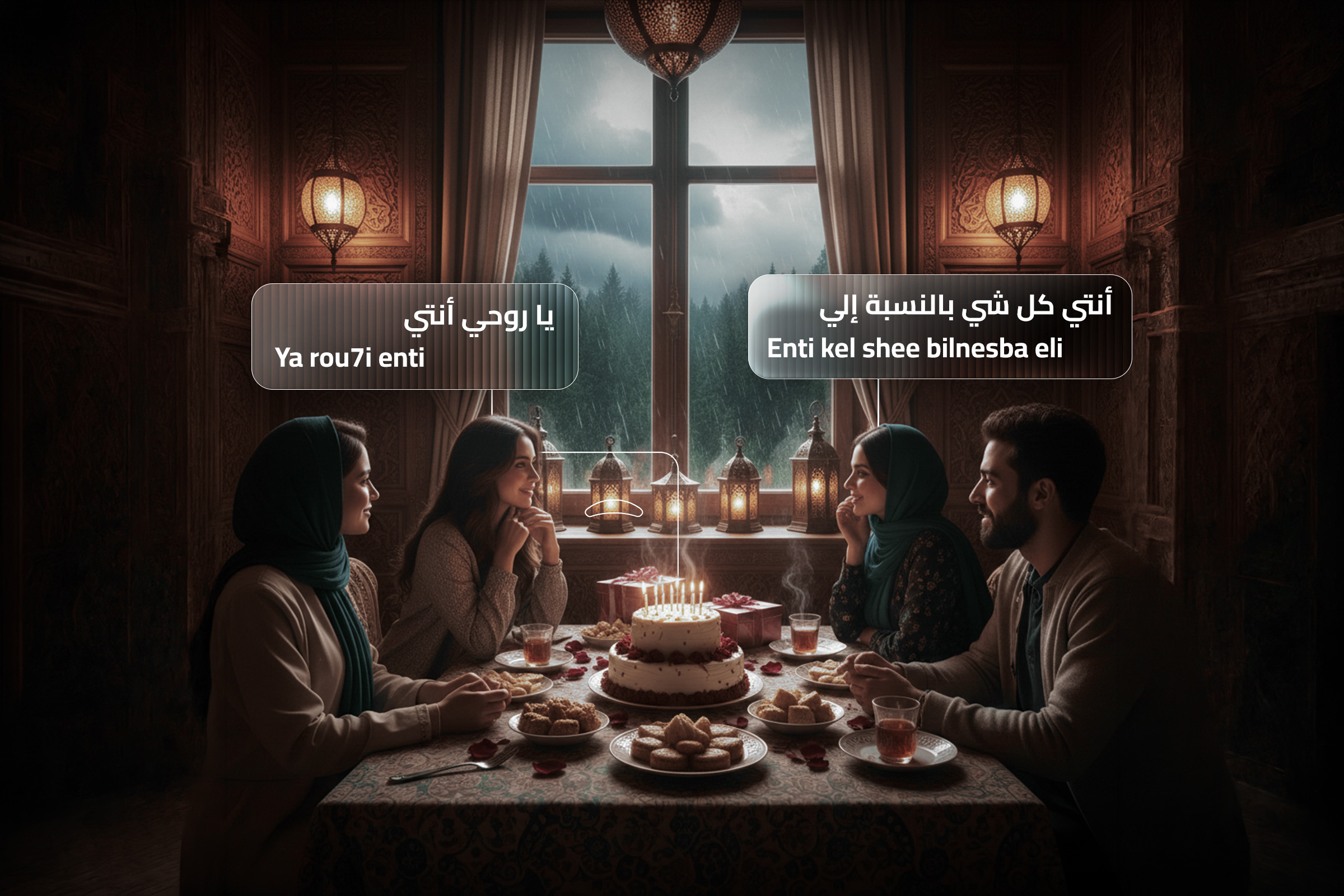
During celebrations such as birthdays, engagements, or even small personal achievements, phrases like “Anti kel shee’ bnesba li” (You are everything to me) are commonly heard. These moments show that affection in Levantine culture is expressed consistently, not only on special occasions.
For learners, recognizing this cultural pattern is essential. Understanding spoken Levantine Arabic allows them to participate naturally in these moments instead of feeling like outsiders.
Valentine’s Day Beyond Words
Valentine’s Day can be a reminder that love is not only expressed in romantic settings, but also in everyday language. Often, the simplest words have the strongest impact. A familiar phrase said at the right moment can mean more than a perfectly structured sentence.
Learning spoken Levantine Arabic helps learners understand:
How affection is expressed naturally.
How tone and context shape meaning.
How relationships are built through language over time.
This is especially important for learners who want to connect with Arabic-speaking partners, friends, or communities on a deeper level. Understanding the emotional logic of the language builds trust and belonging.
Learning Levantine Arabic Through Real Moments
Traditional language learning often focuses on grammar rules and formal structures. While these have their place, they rarely prepare learners for real conversations. Spoken Levantine Arabic teaches something different: how language feels in real life.
At Speak Real Arabic, we design learning experiences around real conversations, cultural context, and everyday expressions. Learners are encouraged to listen, observe, and gradually participate, without pressure to be perfect.
Valentine’s Day is just one example of how language reflects emotion. But the same principles apply every day. Language is not only about what you say, but how you show up for others.
If you’re ready to experience Arabic in a way that feels like everyday life, start your journey with Speak Real Arabic. We guide you through learning that reflects real-world communication, without the pressure of memorization or complicated grammar. Let’s make Arabic a language you live, not just study.
Also Read:
👉 Learn how love is spoken in real Arabic. Say it the Levantine way
👉 Want to say “I love you” like a native? Click, learn, and speak from the heart
👉Ready to say more than “I love you”? Start speaking real Levantine Arabic today, for free.


