Ramadan Mubarak Meaning in Arabic: How to Say It Naturally in Levantine Arabic
What Does Ramadan Mubarak Mean in Arabic?
How Is Ramadan Mubarak Pronounced in Spoken Arabic?
Ramadan Mubarak vs. Ramadan Kareem
When Do People Say Ramadan Mubarak?
How to Respond to Ramadan Mubarak
The Cultural Meaning Behind the Phrase
Ramadan Mubarak in the Diaspora
Every year during the holy month of Ramadan, millions of people around the world say the same phrase:
Ramadan Mubarak.
But what does Ramadan Mubarak meaning in Arabic actually involve?
And how do people say it naturally in everyday spoken Arabic?
If you’re learning Arabic for real conversations، not just textbook phrases, understanding how Ramadan greetings are used in daily life makes a big difference.
Because like many expressions in Arabic, the meaning goes deeper than the literal translation.
What Does Ramadan Mubarak Mean in Arabic?
In Arabic, the phrase is written as:
رمضان مبارك
The word رمضان (Ramadan) refers to the ninth month of the Islamic calendar, a sacred month of fasting, reflection, prayer, and community.
The word مبارك (Mubarak) means “blessed.”
So the direct Ramadan Mubarak meaning in Arabic is:
“Blessed Ramadan.”
But culturally, it means:
🙏 May this month bring you blessings.
🙏 May your fasting be accepted.
🙏 May this time bring peace to your home.
It’s both a greeting and a prayer.
How Is Ramadan Mubarak Pronounced in Spoken Arabic?
In Modern Standard Arabic, you might hear:
Ramadan Mubarak
But in everyday Levantine spoken Arabic, especially in places like Syria, Lebanon, and Jordan, the pronunciation softens slightly.
It often sounds like:
Ramadan Mbarak
The vowel in “Mubarak” becomes lighter and quicker in casual speech.
This small pronunciation shift is important for learners. It helps you sound natural instead of overly formal.
That’s something we focus on inside Speak Real Arabic, how phrases are actually said in real conversations.
Ramadan Mubarak vs. Ramadan Kareem
You may also hear:
رمضان كريم (Ramadan Kareem)
The word كريم (Kareem) means “generous.”
So Ramadan Kareem translates to:
“Generous Ramadan.”
Both greetings are correct. Both are widely used across the Arab world.
The difference is subtle:
✔ Ramadan Mubarak emphasizes blessings.
✔ Ramadan Kareem emphasizes generosity.
In Syrian culture, both are used naturally. Often, people say whichever comes first to mind.
When Do People Say Ramadan Mubarak?
Ramadan Mubarak is typically said:
✔ On the first day of Ramadan
✔ When seeing someone for the first time during the month
✔ In messages and phone calls
✔ On social media posts
✔ During visits before iftar (the meal that breaks the fast)
In cities like Damascus and Aleppo, the greeting becomes part of daily rhythm. Shopkeepers say it to customers. Neighbors say it in the hallway. Families repeat it across dinner tables.
It creates a shared emotional atmosphere.
How to Respond to Ramadan Mubarak
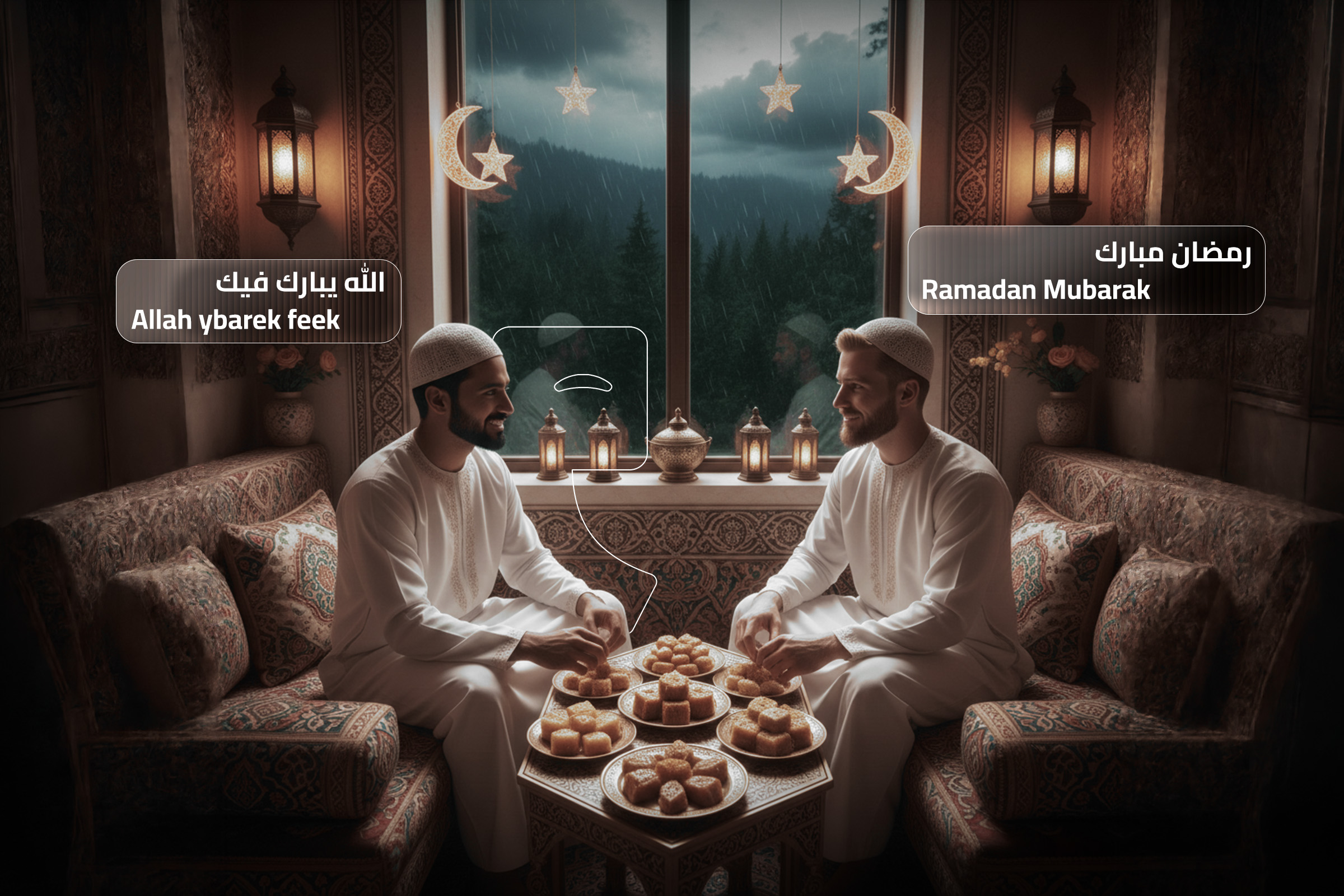
If someone tells you:
“Ramadan Mubarak”
You can reply with:
🟡 علينا وعليك ➝ (Upon us and you too)
🟡 الله يبارك فيك ➝ (May God bless you)
In spoken Arabic, you’ll often hear:
“علينا وعليك” pronounced quickly and warmly.
Learning how to respond is just as important as learning the greeting itself.
Because language is interaction.
At Speak Real Arabic, we always emphasize this: memorizing phrases is only half the process. Knowing how to respond is what builds confidence.
The Cultural Meaning Behind the Phrase
To truly understand Ramadan Mubarak meaning in Arabic, you need to understand Ramadan itself.
Ramadan is not only about fasting from food and drink between sunrise and sunset. It is about:
✔ Patience
✔ Gratitude
✔ Charity
✔ Family gatherings
✔ Spiritual reflection
Homes feel different during Ramadan. Evenings are lively. Lanterns decorate streets. The call to prayer at sunset carries special emotional weight.
Saying Ramadan Mubarak acknowledges all of that.
It’s not just seasonal politeness.
It’s shared experience.
Formal vs. Natural Usage
In formal settings, like speeches or official announcements, you’ll hear the phrase clearly articulated:
⭐ Ramadan Mubarak to you and your family.
In everyday conversation, it becomes shorter and warmer:
⭐ Ramadan Mbarak!
Sometimes even just:
⭐ Mbarak!
This natural shortening is part of Levantine spoken rhythm.
If your goal is to sound natural, listening to how people shorten and soften phrases is essential.
That’s why cultural immersion matters more than memorizing grammar rules alone.
Inside Speak Real Arabic, we focus heavily on these real-life pronunciation shifts that textbooks rarely highlight.
Ramadan Mubarak in the Diaspora
In places like the United States, Canada, and Europe, Arab communities continue using Ramadan Mubarak in Arabic, even when speaking English the rest of the time.
You might hear:
“Ramadan Mubarak, hope your fasting is going well!”
The phrase becomes a cultural anchor.
It carries identity across languages.
For learners of Arabic, this shows something powerful:
Language is not only communication, it’s belonging.
Why Learning Holiday Expressions Matters
Many students focus on verbs, sentence structure, and vocabulary lists.
But greetings like Ramadan Mubarak teach you something deeper:
🟣 How emotions are expressed
🟣 How community bonds are reinforced
🟣 How tone changes meaning
🟣 How pronunciation shifts in real speech
Understanding Ramadan Mubarak meaning in Arabic helps you connect culturally, not just linguistically.
And connection is the real goal of learning any language.
That philosophy shapes everything we teach at Speak Real Arabic, moving from textbook Arabic to real spoken interaction.
Bringing It All Together
So what does Ramadan Mubarak meaning in Arabic truly represent?
Literally:
Blessed Ramadan.
Culturally:
🟡 A wish for peace
🟡 A shared spiritual moment
🟡 A reminder of generosity
🟡 A bridge between people
And in spoken Levantine Arabic, it becomes softer, warmer, and more intimate:
Ramadan Mbarak.
When you learn how to say it naturally, and how to respond, you step into the culture instead of observing it from the outside.
And that’s the difference between studying Arabic and living it.
If you’re ready to learn spoken Arabic the way it’s actually used in daily life—through culture, conversation, and real expressions—explore lessons inside Speak Real Arabic and start speaking naturally from day one.
Also Read:
🎓 Zero to 15 Minutes in Arabic teaches your first conversation.
🎓 60 Minutes in 60 Days expands your vocabulary in topics like food, shopping, and daily life.
🎓 Weekly Arabic, Culture & Stories, Join Our Newsletter


