

How to Learn Syrian Arabic: A Step-by-Step Guide for Beginners
You want to learn Syrian Arabic, but every time you sit down to study, you run into the same questions.
Should you learn the Arabic alphabet first? Do you need to study Modern Standard Arabic? Should you memorize vocabulary, watch Syrian shows, or start speaking right away?
If you're feeling unsure about where to begin, you're not alone.
The good news? You don't need to know hundreds of words or understand complicated grammar rules to start speaking Syrian Arabic.
What you need is a clear starting point, useful everyday expressions, and a way to practice consistently.
In this guide, you'll learn how to learn Syrian Arabic step by step, even if you're starting from zero.
And more importantly, you'll learn how to move beyond memorizing words and start using Arabic in real conversations.
1. Understand What Syrian Arabic Actually Is
Before you begin learning, there's one important distinction to understand.
Syrian Arabic is not the same as Modern Standard Arabic (MSA).
Modern Standard Arabic is used in formal writing, news broadcasts, official communication, and many educational materials.
Syrian Arabic, on the other hand, is the language people use in everyday conversations in Syria.
It's part of the Levantine Arabic dialect family, which also includes varieties spoken in Lebanon, Palestine, and Jordan.
At Speak Real Arabic, we focus on natural spoken Syrian Arabic, particularly the everyday expressions associated with Damascus.
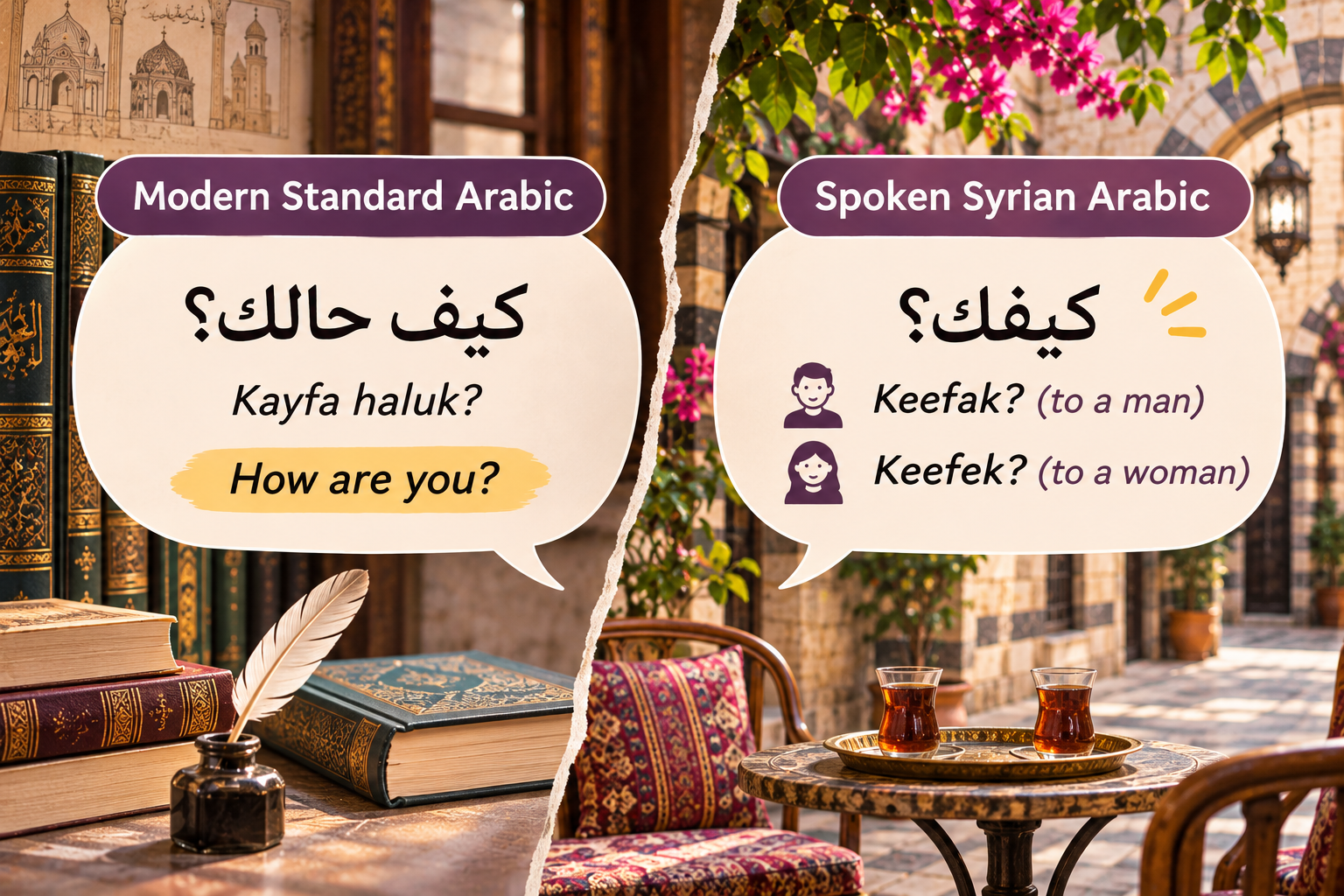
Here's a simple example:
Modern Standard Arabic:
كيف حالك؟
Kayfa haluk?
How are you?
Spoken Syrian Arabic:
كيفك؟
Keefak? (to a man)
Keefek? (to a woman)
How are you?
Both are understandable, but the Syrian version is much more natural in everyday conversation.
If your goal is to speak with Syrian friends, family, colleagues, or people you meet while traveling, learning spoken Syrian Arabic directly can be a practical starting point.
You don't need to master MSA before you begin.
2. Start With the Syrian Arabic Phrases You'll Actually Use
One of the biggest mistakes beginners make is trying to memorize too many words before learning how to use them.
You might know the Arabic words for table, window, and notebook, but still struggle to greet someone.
Instead, begin with expressions that help you connect with people.
10 Essential Syrian Arabic Phrases for Beginners
Syrian Arabic | Pronunciation | English Meaning |
|---|---|---|
مرحبا | Marhaba | Hello |
أهلين | Ahleen | Hi / Welcome |
كيفك؟ | Keefak / Keefek? | How are you? |
منيح / منيحة | Mneeh / Mneeha | Good / Fine |
شو اسمك؟ | Shu ismak / ismek? | What's your name? |
اسمي... | Esmi... | My name is... |
يسلمو | Yislamo | Thanks |
إي | Ee | Yes |
لأ | La' | No |
يلا | Yalla | Let's go / Come on |
Pronunciations are approximate. Some expressions change depending on who you're speaking to.
Notice something?
These aren't random vocabulary words. They're expressions you can use immediately.
And that's exactly where beginners should start.
Try Your First Syrian Arabic Conversation
Imagine meeting a Syrian friend.
A: مرحبا! كيفك؟
Marhaba! Keefak?
Hello! How are you?
B: منيح، الحمد لله. وإنت؟
Mneeh, elhamdulillah. W enta?
Good, thank God. And you?
A: تمام، يسلمو!
Tamam, yislamo!
Great, thanks!
That's already a real exchange.
You don't need advanced grammar to understand it or practice saying it aloud.
💜 Beginner tip: Learn complete phrases before worrying about every individual word. This helps you remember how Syrians naturally put words together.
3. Learn to Listen Before Trying to Understand Everything
Have you ever studied vocabulary and then listened to native speakers, only to realize you couldn't recognize the words?
This happens to many language learners.
In natural Syrian conversations, people speak quickly, connect words, shorten sounds, and use expressions that don't always translate word for word.
⭐ For example:
شو عم تعمل؟
Shu 3am ta3mel?
What are you doing? (to a man)
You might recognize شو (shu, meaning "what"), but the rest of the sentence can sound unfamiliar at first.
The solution isn't to memorize more isolated words.
It's to practice listening to short, understandable conversations.
✔ A Simple Listening Exercise
Choose a short Syrian Arabic conversation, ideally with a transcript.
Listen once without reading.
Listen again while following the Arabic or transliteration.
Identify two or three familiar expressions.
Repeat one sentence aloud.
Listen again without looking at the text.
You don't need to understand every word.
Your goal is to become familiar with the rhythm, sounds, and patterns of spoken Syrian Arabic.
Even ten minutes of focused listening can be a useful part of your daily routine.
4. Don't Wait Until You're Fluent to Start Speaking
A common beginner belief is:
"I'll start speaking once I know enough Arabic."
But speaking is one of the skills that helps you learn the language in the first place.
You can start with very short sentences.
⭐ For example:
بدي قهوة.
Baddi ahwe.
I want coffee.
ما بعرف.
Ma ba3ref.
I don't know.
ما فهمت.
Ma fhemet.
I didn't understand.
ممكن تعيد؟
Mumken t3eed?
Can you repeat? (to a man)
These simple expressions are useful because they help you participate in conversations even when your vocabulary is limited.
💜 Your First Speaking Challenge
Try describing three things you want today.
Start with:
بدي...
Baddi...
I want...
For example:
بدي مي — Baddi mayy — I want water.
بدي قهوة — Baddi ahwe — I want coffee.
بدي أتعلم عربي — Baddi et3allam 3arabi — I want to learn Arabic.
Say each sentence aloud several times.
Then try replacing the final word with something else you've learned.
This is a simple way to begin creating your own sentences instead of repeating memorized lists.
5. Learn Syrian Arabic Grammar Through Real Examples
Do you need grammar to speak Syrian Arabic?
Yes, grammar helps you understand how sentences work.
But that doesn't mean you need to begin with complicated grammar explanations.
For beginners, it's often more helpful to notice patterns in real sentences.
Take the word عم (3am).
In Syrian Arabic, it's commonly used with present-tense verbs to describe actions happening now.
⭐ For example:
شو عم تعمل؟
Shu 3am ta3mel?
What are you doing? (to a man)
عم بدرس عربي.
3am bedros 3arabi.
I'm studying Arabic.
عم بشرب قهوة.
3am beshrab ahwe.
I'm drinking coffee.
Instead of memorizing a long grammar table, begin by noticing how عم appears in these sentences.
As you encounter more examples, the pattern will become more familiar.
Later, you can study how the verbs change with different speakers and situations.
The goal isn't to avoid grammar. It's to learn grammar in a way that supports communication.
6. Learn the Culture Behind Syrian Arabic Expressions
Learning Syrian Arabic isn't only about understanding words.
It's also about understanding how people use those words to express warmth, politeness, appreciation, and connection.
⭐ For example, Syrians often say:
يعطيك العافية
Ya3teek el 3afye
Literally, the expression refers to wishing someone health or strength.
In everyday life, it's commonly used to appreciate someone's work or effort.
You might say it to someone preparing food, helping you with something, or finishing a long day of work.
Another common expression is:
الله يخليك
Allah ykhalleek
Depending on the situation, it can express appreciation, affection, or a warm request.
These expressions are difficult to understand through literal translation alone.
Their meaning becomes clearer when you hear them in real situations.
That's why cultural context is an important part of learning Syrian Arabic.
When you understand not only what to say but also when and why Syrians say it, your conversations begin to feel more natural.
7. Avoid These Common Syrian Arabic Learning Mistakes
Learning a new language takes time, but some habits can make the process more frustrating than it needs to be.
Here are four common mistakes worth avoiding.
❌ Mistake 1: Studying Too Many Resources at Once
You download several apps, follow dozens of Arabic teachers, save hundreds of videos, and switch between different learning methods.
The result?
You collect information without building a clear learning routine.
Try this instead: Choose one main learning path and use other resources for extra listening or practice.
❌ Mistake 2: Mixing Different Arabic Varieties Without Realizing It
You learn one expression from a Syrian teacher, another from an Egyptian video, and a third from an MSA textbook.
All three may be useful, but they don't necessarily belong to the same spoken variety.
Try this instead: If your goal is Syrian Arabic, make Syrian conversations and learning materials your primary reference.
❌ Mistake 3: Memorizing Words Without Context
Knowing a translation doesn't always mean knowing how to use a word.
Try this instead: Learn each new expression inside a short sentence or conversation.
❌ Mistake 4: Waiting for Perfect Pronunciation
Many learners avoid speaking because they're worried about making mistakes.
But pronunciation develops through listening, repetition, feedback, and practice.
Try this instead: Speak slowly, repeat short phrases, and focus on being understood before trying to sound perfect.
8. Your First 30 Days Learning Syrian Arabic
You don't need to study for hours every day to begin making progress.
A simple, consistent routine is often more manageable.
Here's a beginner-friendly 30-day plan.
🟡 Week 1: Learn to Greet People
Focus: Basic greetings and introductions.
Practice:
Saying hello and goodbye.
Asking how someone is.
Introducing yourself.
Recognizing common responses.
Your goal: Complete a short greeting exchange without reading your notes.
🟡 Week 2: Talk About Everyday Needs
Focus: Useful phrases for daily life.
Practice:
Saying what you want.
Asking simple questions.
Ordering food or drinks.
Saying when you don't understand.
Your goal: Use five everyday expressions in your own sentences.
🟡 Week 3: Build Your Listening Skills
Focus: Understanding natural spoken Arabic.
Practice:
Listening to short conversations.
Recognizing familiar phrases.
Repeating sentences aloud.
Noticing common pronunciation patterns.
Your goal: Recognize several expressions in a short conversation without relying entirely on a transcript.
🟡 Week 4: Start Creating Conversations
Focus: Combining what you've learned.
Practice:
Asking and answering simple questions.
Describing everyday activities.
Using common Syrian expressions naturally.
Recording yourself speaking for one minute.
⭐ Your goal: Have a short, prepared conversation or create a simple spoken self-introduction.
Remember, this isn't a promise that you'll become fluent in 30 days.
It's a starting point designed to help you build confidence, consistency, and practical skills.
9. Should You Learn Syrian Arabic on Your Own or Take Lessons?
You can absolutely begin learning Syrian Arabic independently.
Free videos, articles, podcasts, and language exchanges can help you discover useful expressions and practice listening.
But self-study can also come with challenges.
You might wonder:
Am I learning expressions Syrians actually use?
What should I study next?
Am I pronouncing these words correctly?
Why can I understand individual phrases but not full conversations?
How do I know whether I'm making progress?
This is where a more structured learning approach can be helpful.
A clear learning path can help you organize what you're studying, revisit important patterns, and practice skills in a logical order.
And if you have access to speaking practice or feedback, you may find it easier to identify what needs improvement.
The important thing is to choose a learning method that supports your goal.
If you want to understand and speak natural Syrian Arabic, your learning materials should help you practice the language people actually use.
💜 Learn Real Syrian Arabic With Speak Real Arabic
At Speak Real Arabic, we believe learning a language is about more than memorizing vocabulary.
It's about understanding people, connecting through conversation, and discovering the culture behind everyday expressions.
Our focus is on helping learners explore authentic spoken Syrian Arabic, with practical language that belongs in real life.
If you're ready to move from scattered vocabulary lists toward a clearer learning journey, explore Speak Real Arabic and find a learning path that fits your goals.
Explore Syrian Arabic Learning at Speak Real Arabic
10. How to Stay Motivated While Learning Syrian Arabic
Motivation is wonderful when you're beginning a language.
But motivation alone won't always carry you through the difficult days.
Some days, you'll remember every expression you practiced.
Other days, you'll forget a word you've repeated ten times.
That's normal.
Instead of measuring your progress by how many words you know, pay attention to what you can actually do.
Can you greet someone without checking your notes?
Can you recognize a familiar phrase in a conversation?
Can you ask for something in Syrian Arabic?
Can you understand a simple response?
These small achievements matter.
They show that you're beginning to use the language, not just study it.
And that's the foundation of real communication.
Final Thoughts: Start Small, Speak Often, and Keep Going
You don't need to understand everything before you begin speaking Syrian Arabic.
Start with a greeting.
Learn a phrase you can use today.
Listen to how Syrians speak.
Repeat what you hear.
And little by little, begin creating your own conversations.
The goal isn't to memorize an entire language.
It's to build the confidence and skills to connect with people through it.
Ready to take your next step?
Explore Speak Real Arabic and continue your journey toward natural, everyday Syrian Arabic.
Also Read:
🌟Start Zero to 15 Minutes, of real Arabic, without grammar stress. Explore the Course
🌟 Continue exploring Syrian Arabic through real stories, culture, and everyday conversations inside Speak Real Arabic Membership.
🌟 Explore Free Beginner Lessons. click here
🌟 Real Arabic is lived through moments, a philosophy reflected inThe Syrian Encounters.


