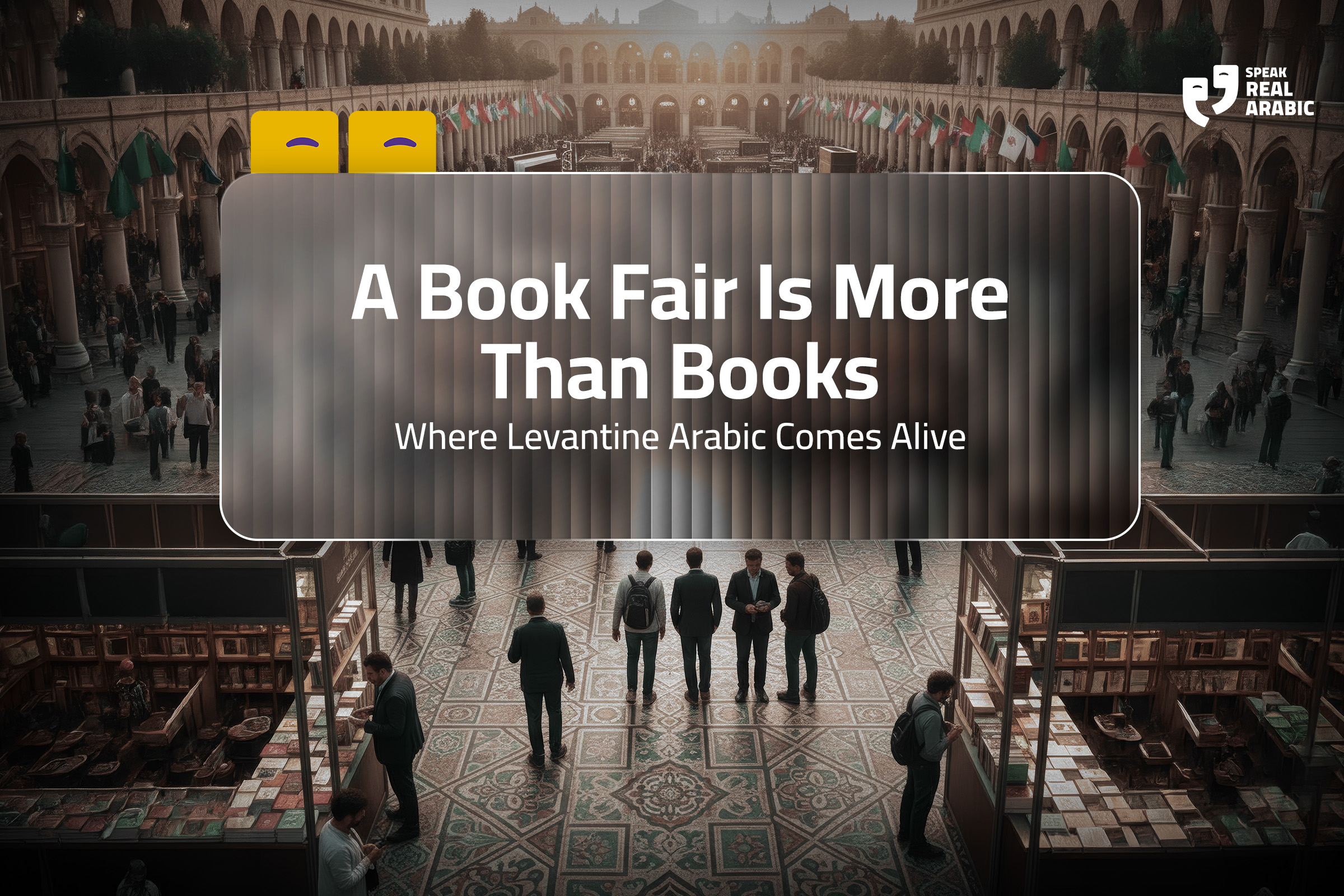
A Book Fair Is More Than Books: Where Levantine Arabic Comes Alive
When people think of learning Arabic, they often picture textbooks, grammar tables, and formal sentences that don’t sound like anything they hear in real life.
But step into an Arabic book fair, and something different happens.
Arabic stops being a subject.
It becomes a sound, a gesture, a moment.
At a book fair, Arabic isn’t locked inside pages. It’s spoken at the stalls, whispered between friends, negotiated over prices, and softened with smiles.
This is where spoken Levantine Arabic comes alive.
Arabic You Hear, Not Arabic You Memorize
You don’t need to buy a single book to learn something valuable at a book fair.
You learn by listening.
A seller says, “Tfaddali.” (تفضلي)
Someone asks, “Addēsh si‘ro?” (قديش سعره)
Another voice answers, “Hād jadīd.” (هاد جديد)
These aren’t textbook sentences.
They’re everyday Levantine Arabic, natural, human, and alive.
This is the kind of Arabic that doesn’t always make it into traditional learning materials, but it’s the Arabic people actually use in daily life. And for learners, hearing Levantine Arabic in real context matters more than understanding every word.
The Space Between the Words
At a book fair, meaning isn’t only in language. It’s in tone, rhythm, and body language.
You start to notice:
🟣 How voices soften when someone is being polite
🟣 How repetition signals emphasis, not confusion
🟣 How a smile can replace a full sentence
For Arabic learners, this is a quiet breakthrough moment: realizing that fluency isn’t about perfection, it’s about connection.
This is especially true when learning spoken Levantine Arabic, where emotion, warmth, and delivery carry as much meaning as the words themselves.
At Speak Real Arabic, we believe this deeply. Language lives in interaction, not in isolation.
Spoken Arabic vs. Written Arabic (Seen Clearly)
Book fairs are one of the rare places where written Arabic and spoken Arabic exist side by side.
On the covers: formal Arabic.
At the stalls: dialect.
You might read a title in Modern Standard Arabic, then hear the seller explain it in Levantine Arabic, switching naturally and effortlessly.
That contrast is powerful. It shows learners something essential:
Written Arabic is learned.
Levantine Arabic is lived.
And both have their place, but only one helps you order coffee, make friends, or feel at home.
“I Don’t Understand Everything”, And That’s Okay
For non-native speakers, Arabic book fairs can feel overwhelming at first. Too many sounds. Too many words. Too much happening.
But here’s the truth:
You’re not supposed to understand everything.
Real language learning begins when you stop translating every word and start observing:
🟡 Which words repeat
🟡 When people laugh
🟡 How conversations open and close
This is how learners slowly tune their ear to spoken Levantine Arabic, the rhythm before the rules.
Understanding comes later. Familiarity comes first.
Small Moments, Real Arabic

The most meaningful Arabic moments at a book fair are rarely dramatic.
They’re small:
🟣 Asking if a book is suitable
🟣 Thanking someone
🟣 Hearing “Ah, mniḥ!” (اي منيح) in approval
These moments teach you something no grammar rule can: how Arabic feels.
This is why Levantine Arabic is such a welcoming entry point for learners. It’s warm, expressive, and deeply human.
It invites you in rather than testing you.
Learning Arabic Outside the Classroom
A book fair reminds us that language doesn’t belong only in classrooms or apps.
It belongs:
🟡 In shared spaces
🟡 In curiosity
🟡 In everyday exchanges
When learners experience Levantine Arabic this way, fear softens. Confidence grows quietly.
At Speak Real Arabic, we design learning with this same philosophy: real conversations, natural flow, and no pressure to be perfect.
Experiencing Arabic Beyond Words
At a book fair, it’s not just about hearing the words, it’s about feeling them. You notice how laughter breaks the tension in a negotiation, or how a simple nod can signal understanding. These subtle cues teach learners what textbooks can’t: the social rhythm of Arabic conversation.
By following these interactions with guidance from Speak Real Arabic, learners can start connecting gestures, tones, and words naturally, making the language come alive in ways that a traditional classroom rarely provides.
Experiencing Arabic Beyond Words
At a book fair, it’s not just about hearing the words, it’s about feeling them. You notice how laughter breaks the tension in a negotiation, or how a simple nod can signal understanding. These subtle cues teach learners what textbooks can’t: the social rhythm of Arabic conversation.
By following these interactions with guidance from Speak Real Arabic, learners can start connecting gestures, tones, and words naturally, making the language come alive in ways that a traditional classroom rarely provides.
Bringing Levantine Arabic into Daily Life
The lessons from a book fair don’t stay at the fair. They follow you home. Whether ordering coffee, chatting with neighbors, or making new friends, the small moments you witness translate into real-life fluency.
Courses and exercises from Speak Real Arabic help learners practice these everyday expressions, turning passive observation into active communication, and reinforcing the warm, human side of Levantine Arabic.
Also Read:
🌟Just like a book fair, real Arabic is lived through moments, a philosophy reflected in The Syrian Encounters.
🌟 And many of those moments begin with family, explored in The Family Tree.
🌟 Start Zero to 15 Minutes, of real Arabic, without grammar stress, Explore the Course


